
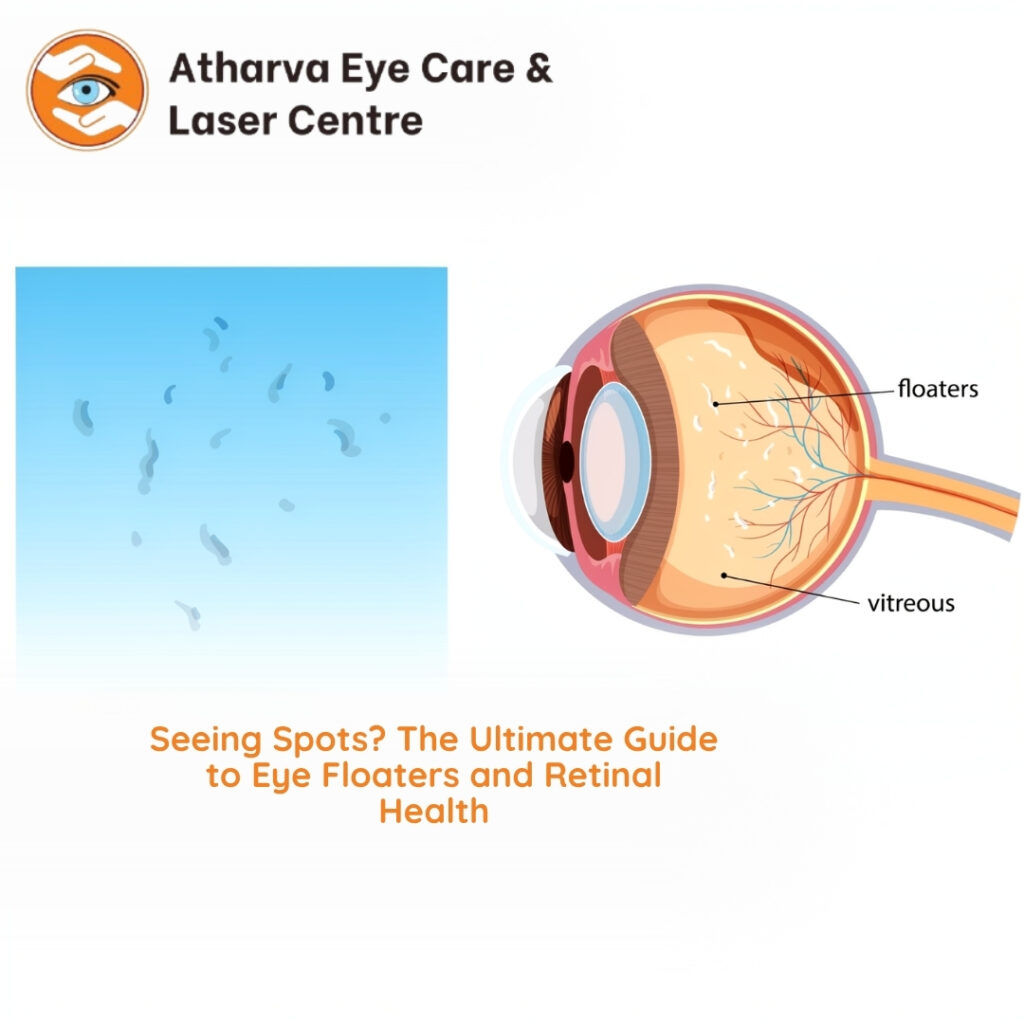
Seeing Spots? The Ultimate Guide to Eye Floaters and Retinal Health
Have you ever stared up at a clear, bright blue sky or gazed at a blank white wall, only to notice tiny black dots, squiggly lines, or shadowy cobwebs drifting across your field of vision? You might have even tried to swat them away, thinking a mosquito was buzzing right in front of your face.
If this sounds familiar, you are not alone. These visual anomalies are incredibly common, and they have a specific medical name: Eye Floaters (or Muscae volitantes, which translates from Latin to “flying flies”).
While noticing these floaters for the first time can be an unsettling experience, understanding what they are, why they form, and how they interact with your eye’s anatomy can put your mind at ease. More importantly, knowing when these little shadows signal a serious medical emergency can quite literally save your sight.
Here is everything you need to know about eye floaters, straight from the science of the eye to the warning signs you should never ignore.
What Exactly Are Eye Floaters?
To understand what eye floaters are, we first need to look at the anatomy of the human eye.
The large, middle section of your eye—between the lens at the front and the retina at the back—is filled with a clear, gel-like substance called the vitreous humor (or simply, the vitreous). This gel helps the eye maintain its round shape and provides a clear pathway for light to travel through to the retina.
When we are young, the vitreous has a thick, perfectly uniform, gelatin-like consistency. However, as we age, this gel undergoes a natural physical transformation. The vitreous slowly begins to shrink, liquefy, and become stringy—a process known as syneresis.
As the gel degenerates, microscopic fibers of collagen protein inside the vitreous tend to clump together. These tiny clumps float freely within the more liquid areas of the gel.
Here is the fascinating part: you aren’t actually seeing the clumps themselves. When light enters your eye, these protein clusters block some of the light, casting tiny shadows onto your retina (the light-sensitive tissue at the back of your eye). Those shadows are the floaters you see drifting across your vision!
Why Do They Stand Out Against Bright Backgrounds?
You probably don’t notice your floaters when you are in a dimly lit room or looking at a dark and complex pattern. They become highly visible when you are looking at bright, uniform backgrounds—like a clear sky, a snowy landscape, a blank white wall, or the bright white background of your mobile screen or computer monitor.
The bright, uniform light forces your pupils to contract (making the light sharper) and creates a high-contrast backdrop, making the shadows cast on your retina much more defined and noticeable. Furthermore, because these particles are suspended in the vitreous fluid, they move when your eyes move. When you try to look directly at them, they seem to dart away, following the motion of your eye fluid.
Are Eye Floaters Dangerous?
The short answer is: Most of the time, no.
If you have had a few floaters that occasionally drift into your line of sight for years, they are highly likely to be benign. Age-related changes to the vitreous gel are completely normal. In fact, most people develop some degree of eye floaters as they reach their 40s, 50s, and 60s.
Over time, your brain actually performs an incredible feat of neural adaptation. It learns to simply “tune out” these shadows, meaning you will notice them less and less, even if they are physically still present in your eye.
However, while age is the most common cause, floaters can also be triggered or exacerbated by:
-
Nearsightedness (Myopia): People who are very nearsighted often experience vitreous degeneration at a younger age.
-
Eye Trauma: A physical blow to the eye can cause floaters.
-
Diabetic Retinopathy: Fluctuating blood sugar levels can damage the blood vessels in the retina.
The Red Flags: When Should You Be Worried?
While a few chronic floaters are perfectly normal, sudden changes in your vision are not.
As the vitreous shrinks with age, it slowly peels away from the retina. This is called a Posterior Vitreous Detachment (PVD), and it is usually a harmless, natural process. However, in some cases, the shrinking gel can stick to the retina too tightly and pull on it. If it pulls hard enough, it can tear the retina or even pull it completely away from the back of the eye (a Retinal Detachment).
A retinal detachment is a severe medical emergency. If left untreated, it can lead to permanent, irreversible blindness within days.
You must see an eye doctor or retina specialist IMMEDIATELY if you experience any of the following symptoms:
-
A Sudden Shower of New Floaters: If you suddenly see dozens or hundreds of new floaters, spots, or “spider webs” appearing all at once, this could indicate that a retinal tear has caused bleeding into the vitreous.
-
Flashes of Light (Photopsia): If you see bright flashes of light, lightning streaks, or camera-like flashes in your peripheral vision, it means the vitreous gel is actively tugging on your retina.
-
Loss of Peripheral Vision: If you notice a dark shadow or a “gray curtain” falling over the sides, top, or bottom of your vision, this is a classic hallmark of a retinal detachment.
Diagnosis and Treatment
If you experience these warning signs, your eye doctor will perform a comprehensive, dilated eye exam. By putting special drops in your eyes to widen your pupils, the doctor can use specialized equipment to look deep into the back of your eye and check your retina for any tears, holes, or detachments.
If a retinal tear is caught early, it can often be treated in an outpatient setting using a specialized laser to essentially “weld” the retina back into place, preventing a full detachment.
For ordinary, harmless floaters, treatment is rarely recommended. The risks of eye surgery far outweigh the annoyance of a few wandering dots. However, in extreme cases where dense floaters severely impair a patient’s ability to read or drive, a surgeon may perform a vitrectomy (removing the vitreous gel and replacing it with a saline solution) or use a specialized laser to break up the larger clumps.
The Takeaway: Listen to Your Eyes
Your eyes are incredibly complex and delicate organs. While those little floating cobwebs are usually just a harmless sign of passing time, they serve as a great reminder that our visual health requires active maintenance.
Never ignore sudden changes in your eyes. If your vision shifts overnight, treat it as an emergency.
Do you frequently see floaters, or has it been more than a year since your last comprehensive eye exam? Don’t leave your vision to chance. Take the proactive step to protect your sight and schedule a retinal checkup with your eye care professional today.
